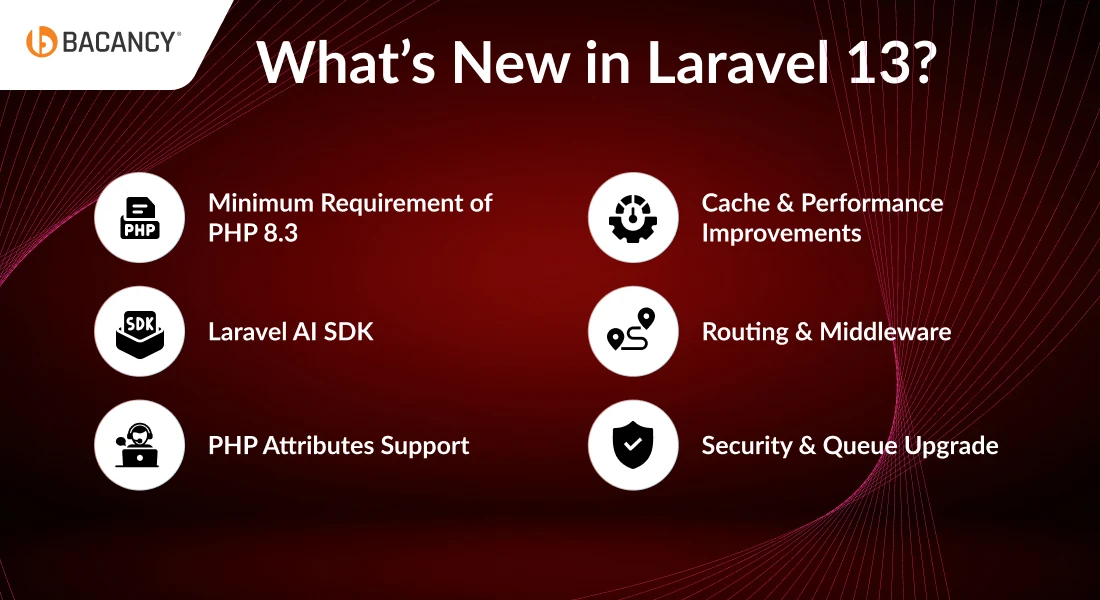
Laravel 13 was officially released on March 17th, 2026, focusing on framework stability and quality-of-life improvements rather than breaking changes. The major highlights include a minimum requirement of PHP 8.3, native support for PHP Attributes, a first-party AI SDK, and efficient cache management via Cache::touch()
Table of Contents
Introduction
The Laravel team has announced the official release of Laravel 13. This release cycle is unique and forward-looking, as the team has minimized breaking changes and introduced features that align with current development trends, such as AI integration, declarative configurations, and high-performance applications.
From our experience working with enterprise Laravel applications at Bacancy, one clear trend stands out: teams are prioritizing clean architecture, faster execution, and automation-driven development. Laravel 13 directly supports these priorities.
What’s New in Laravel 13? Latest Features and Updates
1. Minimum Requirement of PHP 8.3
Laravel 13 officially drops support for PHP 8.1 and 8.2, and there are concrete reasons behind that decision. PHP 8.1 reached end-of-life in December 2025, meaning it no longer receives security patches or bug fixes.
For any application that is running in production, staying on an unsupported PHP version is an active security risk that no framework update can compensate for.
PHP 8.3 is the new minimum, and it brings meaningful improvements to the language: typed class constants, the json_validate() function, and JIT compiler enhancements that deliver measurable performance gains in compute-intensive workloads. One critical point before starting your upgrade is to always upgrade your PHP version first, before updating any Composer dependencies.
Running composer update on a PHP 8.2 environment while targeting Laravel 13 will cause dependency resolution failures. You must confirm your environment is on PHP 8.3+ using php -v, then proceed with the rest of the Laravel migration.
2. Laravel AI SDK
The first-party Laravel AI SDK is the most significant addition in Laravel 13, and it fundamentally changes how PHP development teams approach AI integration.
This is not a community-maintained wrapper or a third-party abstraction layer. It is an official Laravel package that provides a unified API for text generation, tool-calling agents, image processing, audio synthesis, embeddings, and vector-store integrations. For companies also exposing their Laravel app to external AI agents like Claude Desktop, Cursor, or ChatGPT, Laravel MCP is the natural companion to the AI SDK.
It supports Anthropic, OpenAI, and Google Gemini simultaneously, with built-in provider fallback logic and full testability across all supported providers.
use Laravel\Ai\Audio;

$audio = Audio::of('Welcome to our platform.')->generate();
Native Vector Search and Semantic Query Builder
Laravel 13 introduces whereVectorSimilarTo() natively in the Eloquent query builder, powered by PostgreSQL and pgvector. This makes semantic similarity search a first-class capability within Laravel’s database layer. Bonus points are that no separate service, additional infrastructure, or third-party package is required.
php$documents = DB::table('documents')
    ->whereVectorSimilarTo('embedding', 'Best practices for API security')
    ->limit(10)
    ->get();
It is ideal for development teams who want to build AI-powered search, RAG (Retrieval-Augmented Generation) pipelines, recommendation engines, or document retrieval systems; this is a meaningful architectural simplification.
What previously required a standalone vector database or a custom pgvector integration outside of Laravel’s ORM can now be handled directly within the query builder. That reduction in infrastructure complexity translates directly into faster development cycles and easier maintenance.
3. PHP Attributes Support
Laravel 13 introduces native PHP 8 Attribute support across more than 15 framework locations, including Eloquent models, jobs, mailables, listeners, and console commands. This provides a clean alternative to the traditional class property approach for configuring Laravel components.
Rather than defining $table, $primaryKey, $hidden, $fillable, and similar properties at the top of every model, developers can now declare them inline using PHP attributes:
php#[Table('users', key: 'user_id', keyType: 'string', incrementing: false)]
class User extends Model {}
php#[UseResource(UserResource::class)]
#[UseResourceCollection(UserResourceCollection::class)]
class User extends Model {}
This is a fully backward-compatible, optional change. With the existing property-based configuration, you can continue to work without modification. Your teams can choose to adopt attributes incrementally, or not at all, without any impact on application behavior.
That said, for codebases where model readability and onboarding clarity are priorities, the attribute-based approach produces noticeably cleaner class definitions.
4. Cache & Performance Improvements
Laravel 13 introduces a session-scoped cache layer, which is a dedicated cache store that is automatically isolated per user session. Unlike the global application cache, which requires developers to manually namespace cache keys to prevent cross-session data collisions, the session cache handles isolation internally and clears itself when the session expires or is destroyed.
In high-traffic applications, managing per-user cache data through the global cache is a common source of subtle bugs. Stale data surfacing for the wrong user, memory overhead from orphaned cache entries, and race conditions under concurrent load are all issues that teams regularly encounter.
The session cache addresses all of these at the framework level, rather than leaving them to per-project conventions that vary across teams and codebases.
5. Routing & Middleware
Laravel 13 introduces two targeted improvements to routing and middleware that address long-standing pain points in specific application architectures.
On the routing side, domain-specific routes now automatically take priority over generic routes during resolution. For multi-tenant applications that rely on subdomain routing alongside wildcard routes, this eliminates a category of resolution conflicts that previously required explicit ordering or custom middleware to manage.
On the middleware side, the CSRF protection layer has been refactored and formalized as PreventRequestForgery. Beyond the rename, it now performs origin-aware request verification, validating the request’s origin header in addition to the standard CSRF token.
This dual-layer check provides stronger protection against cross-site request forgery attacks that pass token validation but originate from an unauthorized domain.
php// app/Http/Kernel.php -- update any direct references
protected $middlewareGroups = [
    'web' => [
        \Illuminate\Foundation\Http\Middleware\PreventRequestForgery::class,
        // ...
    ],
];
If your application has custom middleware that extends or directly references the previous CSRF class, those references must be updated before deploying to Laravel 13.
6. Security & Queue Upgrades
Two queue-related additions in Laravel 13 are particularly relevant for teams running production environments where reliability and availability are non-negotiable.
Failover queue driver, Laravel 13 introduces a native failover driver that automatically reroutes jobs to the next configured connection when the primary connection becomes unavailable. This requires no custom retry logic and no manual intervention. Failed connections are handled transparently at the driver level.
Queue::route() allows teams to define default queue connections and names for specific job classes from a single, centralized location. For large applications with many job classes, this eliminates the pattern of scattering $queue and $connection properties across individual job files, which is a practice that makes queue configuration difficult to audit and maintain as the codebase grows.
The HTTP client also receives an afterResponse hook in this release, allowing developers to inspect, log, or transform responses after they are returned, without requiring custom wrapper logic around individual HTTP calls.
Need Assistance With Upgrading to Laravel 13?
Hire Laravel developers to ensure a smooth, secure, and hassle-free migration while keeping your application optimized, stable, and ready for future growth.
What’s Removed in Laravel 13?
The majority of removals in Laravel 13 will have minimal impact on most applications. The most significant change is the complete removal of PHP 8.1 and 8.2 support. In addition, backward-compatibility polyfills accumulated across previous release cycles have been cleared, and all Composer dependencies have been aligned to consistent ^13.0 versioning.
There are 4 specific areas worth auditing in your codebase before upgrading:
Named arguments on framework methods: PHP 8.3 may have introduced parameter name changes in locations where your code uses named arguments on core framework methods.
Custom CSRF middleware: Any class that extends or directly references the old CSRF middleware must be updated to reference PreventRequestForgery.
Third-party AI packages: if your application uses openai-php/laravel or echolabs/prism, evaluate whether the first-party AI SDK covers those use cases before deciding whether to retain them.
Legacy Symfony compatibility layers: It removed as part of the framework’s alignment to Symfony 7.4 and 8.0.
Laravel 12 vs Laravel 13 - Quick Comparison
A quick breakdown of Laravel 12 and Laravel 13 to help you evaluate improvements and decide the best version for your project.
Aspect
Laravel 13
Laravel 12
PHP Version
PHP 8.3 (Mandatory)
PHP 8.2
AI Support
Native SDK
External
Code Structure
Attribute-driven
Config-heavy
Performance
Optimized
Stable
Deprecated Features
Removed
Present
Step-by-Step Guide on How to Upgrade from Laravel 12 to Laravel 13?
Follow this Laravel 13 upgrade guide to move your application safely, avoid breaking changes, and ensure full compatibility with the latest version.
Step 1: Upgrade PHP to 8.3
Laravel 13 requires PHP 8.3, so ensure your development, staging, and production environments are running PHP 8.3 (or higher).
Run this command to verify the PHP version:
php -v
If you are running a lower version, you’ll need to upgrade PHP to 8.3.
Step 2: Update Composer Dependencies
Update Laravel to version 13 by modifying your composer.json:
composer require laravel/framework:^13.0
Then, update other dependencies with:
composer update
You must ensure all your packages are compatible with Laravel 13.
Step 3: Audit and Refactor Codebase
Check your code for deprecated features:
Helper functions removed or changed
Old middleware registration patterns
Outdated authentication scaffolding
Use tools such as PHPStan or Larastan to identify any compatibility issues.
Step 4: Run Automated Tests
You need to ensure your tests are comprehensive, and run your test suite:
php artisan test
Fix any failing tests before moving forward.
Step 5: Clear Caches and Optimize
You must clear the old configuration, route, and view caches:
This ensures that your app is running the latest changes.
Is Your App Ready for Laravel 13? Pre-Upgrade Checklist
Work through this upgrade checklist before touching a single dependency:
PHP 8.3+ confirmed on local, staging, and production environments
All third-party packages have a 13.0-compatible release on Packagist
Named argument usage on core framework methods audited
Deprecated methods scanned with Rector or Laravel Shift
Custom CSRF middleware references updated to PreventRequestForgery
Third-party AI packages reviewed against the new first-party AI SDK
Queue worker configs tested with the failover driver behavior
Full test suite passing before the upgrade begins
Database backup completed and verified
The staging environment is tested end-to-end before production deployment
Conclusion
Laravel 13 is a powerful release that elevates the Laravel framework to new heights by offering a perfect blend of performance, developer productivity, and future-proof features. With PHP 8.3, enhanced AI SDK, attribute-based programming, and improved caching mechanisms, Laravel 13 is designed to meet the demands of modern web development, particularly for scalable, high-performance applications.
As a leading Laravel development company, Bacancy recognizes the significance of adopting the latest advancements in technology to deliver innovative, robust, and scalable solutions. By embracing Laravel 13, we empower businesses to create faster, more efficient applications that align with the evolving landscape of web development.
Whether you are planning to upgrade your existing Laravel application or build a new project from scratch, Bacancy’s expert Laravel development team is here to ensure a smooth transition and provide continuous support to help your business grow.
Frequently Asked Questions (FAQs)
Release Information
Laravel 13 was officially released on March 17, 2026. This release follows Laravel’s predictable yearly release cycle and introduces improvements focused on performance, stability, and developer experience.
The primary focus of the Laravel 13 release was to minimize breaking changes while delivering meaningful, incremental improvements. The goal was to enhance performance, streamline development workflows, and improve overall quality without disrupting existing applications.
Based on Laravel’s annual release pattern, Laravel 14 is expected in early 2027. This predictable cycle helps teams plan upgrades and stay aligned with the latest improvements.
Technical Requirements & Compatibility
Laravel 13 requires PHP 8.3 or higher as the minimum supported version. This ensures compatibility with modern PHP features and improved performance.
No, PHP 8.2 is no longer supported in Laravel 13. Applications must upgrade to PHP 8.3 or later to use this version.
Laravel 13 supports PHP 8.3 through PHP 8.5 as it allows developers to leverage the latest language improvements and optimizations.
New Features & Functionality
Laravel 13 introduces native PHP Attributes for configuring Models, Jobs, and Console Commands across 15+ areas. However, it is completely optional, meaning existing applications can continue using traditional configurations without any changes.
The Cache::touch() method allows developers to extend the expiration time (TTL) of a cached item without retrieving or rewriting its value. This improves efficiency by reducing unnecessary data transfer and helps keep frequently used cache data alive longer with minimal overhead.
Laravel 13 introduces a powerful AI SDK that provides a unified interface for working with AI services. It includes support for:
Text generation
Tool-calling agents
Embeddings
Audio and image processing
Vector store integrations
Yes, Laravel 13 includes native vector query support, enabling developers to build AI-driven search and recommendation systems. It works seamlessly with PostgreSQL and pgvector, making it easier to implement semantic search and embedding-based workflows.
Upgrading & Support
Laravel 13 will receive bug fixes until Q3 2027 and security updates until Q1 2028. It ensures long-term stability and security for production applications.
Laravel provides multiple upgrade options:
The boost command, which uses AI assistance to help automate parts of the upgrade process
Laravel Shift, a third-party tool that delivers automated upgrades through structured pull requests
Bug fixes for Laravel 12 are scheduled to end on August 13, 2026. After this date, only security updates will continue for a limited period, so upgrading is recommended to stay fully supported.
Nikunj Padhiyar
Director of Engineering at Bacancy
Senior Software Engineer building robust, high-performing PHP web applications.