Quick Summary
This article covers ten popular cloud automation tools that can help you save time, reduce errors, and run your cloud systems more smoothly. You’ll learn what each tool does, when to use it, and how it fits in real-world use cases. Whether you’re using AWS, Azure, Google Cloud, or a mix of all three, these tools will work for you.
Table of Contents
Introduction
Manually managing your cloud environments can get tricky, as there are updates to apply, services to monitor, backups to schedule, and security rules to manage. Doing all this takes a lot of time, and mistakes are easy to make. That’s where cloud automation tools come into the discussion.
These tools can help you automate basic, time-consuming tasks, reduce manual errors, and keep your cloud operations smooth and error-free. Whether your teams are working on a small cloud setup or managing a large enterprise cloud environment, these tools can help save valuable time and money, freeing up more room for growth and innovation.
Here’s a fact: According to Gartner, companies that adopted cloud automation were able to reduce downtime by up to 70% and cut operational costs by at least 30%. This shows that automation not only helps save money but can also help run your business more smoothly and efficiently.
With so many tools available, it can be hard to figure out which one is right for you.
In this article, we’ll walk you through the top ten cloud automation tools in 2026 and cover the key benefits and use cases for each tool in a way that’s easy to understand.
Let’s get started.
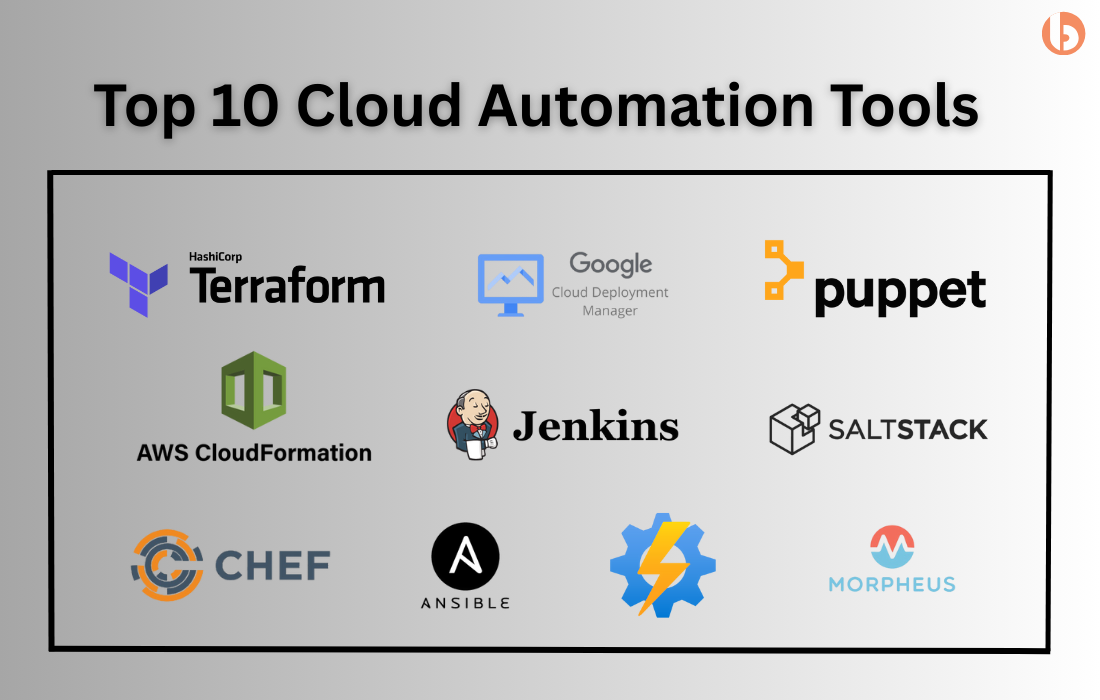
Top 10 Cloud Automation Tools To Use
Here’s a detailed breakdown of the eight key cloud automation tools you need to use in 2026. These tools can help you automate your cloud operations, saving your team time for other essential tasks.
1. Terraform
Terraform, developed by Hashicorp, is one of the most popular cloud automation tools available in the market. Basically, It is an Infrastructure as Code (IaC) tool that allows you to define cloud infrastructure using simple code files.
Instead of manually provisioning servers or networks, you write a blueprint, and Terraform builds it for you. And the best part? You can use the same blueprint across AWS, Azure, Google Cloud, and others.
Benefits:
- Multi-cloud Support: Allows you to manage your infrastructure across different cloud platforms.
- Repeatable Setups: Lets you reuse your code to recreate the same infrastructure at any time, saving time and ensuring consistency across your setups.
- Version Control: You can track every change you make, which is helpful if you want to roll back to a previous, stable version or reverse any change.
- Fast and Reliable Deployments: It helps you automate cloud environment creation in minutes, reducing the potential for human errors.
When Should You Use It:
- You should use it to scale your cloud infrastructure based on demand quickly.
- When you’re working with a multi-cloud environment, and you want consistency across platforms.
- When you need to automate disaster recovery processes, this tool allows you to recreate infrastructure quickly.
Many tech companies, including Shopify and Slack, use Terraform to manage scalable, multi-cloud infrastructure with version control.
Hire Terraform Developers to help you do it the right way.
2. Ansible
Ansible is a tool for automating routine IT tasks, such as software installs, security patches, and system configurations. It’s agentless, meaning it doesn’t require extra software on each machine; just a simple connection is enough.
It’s perfect for both cloud and on-premises environments.
Benefits:
- Easy to Learn: Uses simple YAML files for automation, making it easy to learn even for non-programmers.
- Cross-Platform Flexibility: Supports a variety of systems and cloud providers, even for on-premises setups, offering multi-cloud and hybrid cloud support.
- No Agents Required: Simplifies management and reduces overhead by not requiring extra agents to be installed on each machine.
When Should You Use It:
- To automate repetitive administrative tasks, such as applying software updates or managing security patches across multiple systems.
- If your environment is hybrid, including both on-prem and cloud infrastructure, and you want a unified tool to manage both.
- When you want configuration management for a large-scale infrastructure.
Organizations like NASA and Capital One rely on Ansible to automate routine server tasks and maintain consistent environments across hybrid setups.
3. AWS CloudFormation
AWS CloudFormation is Amazon’s native tool for automating AWS infrastructure. With CloudFormation, you define what resources (like EC2, RDS, S3) you need in a file, and AWS builds it for you.
Benefits:
- AWS-Specific Integration: Seamlessly integrated with all AWS services, allowing you to manage all AWS resources effectively.
- Reduced Errors: Automates resource creation, minimizing the risk of manual configuration mistakes.
- Change Management: Lets you preview changes before applying them, which can help you ensure that updates don’t cause any unwanted harm to your environment.
When Should You Use It:
- When your teams manage complex AWS infrastructure, and you want to automate resource provisioning and updates.
- To create and manage environments as part of a CI/CD pipeline in AWS.
- When compliance and consistency are essential, and you want to enforce standards across all AWS environments using reusable templates.
Enterprises such as Netflix use CloudFormation to automate resource provisioning and standardize their infrastructure deployments within AWS.
4. Azure Automation
Azure Automation is Microsoft’s solution for automating cloud tasks in Azure. It allows you to run scripts, manage updates, and schedule recurring tasks, all of these from a centralized platform.
It even works with hybrid setups, covering both cloud and on-premises servers.
Benefits:
- Cost Savings: Automates actions like shutting down idle VMs, saving on operational costs.
- Patch Management: Ensures systems are always up-to-date with the latest security patches without manual intervention.
- Hybrid Support: Can work across both Azure and on-premises systems, making it ideal for hybrid cloud setups.
When Should You Use It:
- There is a need to automate routine tasks like shutting down unused virtual machines and others to save costs.
- You might need to implement security patch management for your Azure infrastructure without any manual intervention.
- When you are managing a hybrid environment and want to automate tasks in both places, i.e., on-premises and in Azure.
Companies like Adobe use Azure Automation to manage updates and automate daily tasks across cloud and hybrid systems.
5. Google Cloud Deployment Manager
Google Cloud Deployment Manager is cloud automation software that helps you automate and define infrastructure as code within Google Cloud. It is very similar to the Terraform but made specifically for Google services.
With this tool, you can write YAML or Jinja2 templates that describe the resources you want, and it will create them.
Benefits:
- Cloud-Native Integration: Seamlessly integrates with Google Cloud services for streamlined management.
- Template-Based Deployments: Lets you reuse and modify templates quickly for faster project setup and consistent deployments.
- Easy Rollback: Helps undo any changes effortlessly and recover from misconfigurations without the struggle.
When Should You Use It:
- When your team is deploying infrastructure across multiple Google Cloud regions and needs a consistent, automated setup.
- When your team is moving workloads to Google Cloud and needs to automate the provisioning of resources.
- To set up sandbox environments for testing and development.
Businesses like Spotify use Deployment Manager to consistently deploy infrastructure across multiple Google Cloud environments.
6. Puppet
Puppet is a cloud automation tool that is specifically designed to enforce a desired state across your systems. If a setting gets off track from what’s expected, Puppet automatically brings it back in line with the desired state.
Benefits:
- Continuous Configuration Management: Ensures that systems are always in the desired configuration state, automatically correcting any deviations.
- Custom Rules: You can tailor this tool as per your specific needs and with customizable configurations.
- Comprehensive Reporting: Provides detailed reports on system states, making managing large infrastructures easy.
When Should You Use It:
- To enforce strict configuration management and prevent configuration drift across many machines.
- If you have a large-scale enterprise infrastructure and need a tool that can enforce a single policy, ensuring consistency across thousands of systems.
- When your organization is preparing for audits, you need automated compliance checks with detailed logs.
Firms like Google and CERN use Puppet to ensure infrastructure compliance and maintain configuration consistency at scale.
7. Jenkins (with Cloud Plugins)
Jenkins is a popular open-source automation server for building, testing, and deploying software. With cloud plugins, Jenkins can push code to cloud platforms like AWS, Azure, and Google Cloud.
Benefits:
- Extensive Plugin Ecosystem: Lets you access a wide variety of plugins to extend functionality for different cloud providers.
- Customizable Pipelines: This option allows you to design tailored CI/CD pipelines to match your specific development and deployment needs.
- Rapid Feedback: With Jenkins, you can receive immediate feedback on code changes, which can help quickly identify and resolve issues during development.
When Should You Use It:
- When you build and deploy applications through CI/CD pipelines in cloud environments like AWS, Azure, or GCP.
- If you need to automate testing and deployment to reduce manual intervention and speed up time to production.
- When performing rolling updates, you can use this tool to ensure smooth deployments with minimal downtime.
Companies like LinkedIn and eBay use Jenkins to automate builds and deployments in cloud-based CI/CD pipelines.
8. SaltStack
SaltStack is an automation engine, tailored for real-time system updates and large-scale configurations. It’s known for its speed and its ability to respond instantly to any kind of system changes or failures. This tool works well in data centers and cloud setups.
Benefits:
- Real-Time Automation: Responds instantly to changes in your systems, providing immediate updates or corrections.
- Scalability: Efficiently manages thousands of nodes without sacrificing performance.
- Event-Driven Architecture: Automates actions based on real-time events, enhancing system intelligence.
When Should You Use It:
- When you need real-time updates or system reactions, such as fixing failures before they impact users.
- If you’re managing a large-scale infrastructure and need to ensure automation doesn’t slow down as your environment grows.
- If you require self-healing systems that can automatically fix or restart services without manual intervention.
Organizations like IBM (also LinkedIn) use SaltStack for high-speed automation and real-time event-driven responses in large infrastructures.
9. Chef
Chef is an automation tool for managing infrastructure using code. It can work with cloud platforms like AWS, Azure, and Google Cloud, as well as with on-premise systems.
Benefits:
- Infrastructure as Code: It can help you enable scalable and repeatable system configurations across environments.
- Test-Driven Infrastructure: You can test your configurations before pushing them live, which reduces the risk of misconfigurations.
- DevOps Friendly: Chef can easily integrate with CI/CD pipelines and help you speed up deployments.
When Should You Use It:
- When you require advanced automation capabilities for managing complex infrastructure in a DevOps workflow.
- To maintain policy compliance across hundreds of servers with minimal manual intervention.
- When you are managing mixed environments (cloud and on-premises), and want consistent configurations at every place.
Firms such as Facebook and Nordstrom rely on Chef to manage and automate configuration across diverse environments.
10. Morpheus
Morpheus, the last tool in the list of our 10 cloud automation tools, is actually a cloud management and orchestration platform designed to centralize management across multiple cloud platforms, containers, and on-premise infrastructure. It is a complete solution that supports self-service provisioning, governance, automation, and cost control.
Benefits:
- Multi-Cloud Management: Supports AWS, Azure, GCP, VMware, OpenStack, and more from one dashboard.
- Self-Service Portal: Gives development and operations teams the power to provision and manage infrastructure through a customizable UI.
- Built-In Cost Optimization: Tracks cloud usage and helps manage costs with intelligent policies and analytics.
When Should You Use It:
- If you are running a complex, multi-cloud strategy and want to centralize governance and automation.
- When your teams need to set up their own infrastructure, and you still want visibility and control while giving them the freedom.
- If you want to control your cloud waste and get better visibility of your cloud costs and usage
Enterprises like AstraZeneca use Morpheus to orchestrate infrastructure across multiple clouds while optimizing cost and governance.
Conclusion
Well, various cloud automation tools like Terraform, Ansible, Chef, AWS CloudFormation, Azure Automation, Google Cloud Deployment Manager, etc., are making cloud management easier for businesses of all sizes. They help automate time-consuming tasks, reduce errors, and keep systems running smoothly.
Since each tool has its strengths, the best choice really depends on your goals and the cloud platform you’re using. If you’re not sure which one fits your setup, consider working with an IT service provider that specializes in cloud managed services. Their team of experts can help you choose the right tools and set up a strategy that works best for your business.
Frequently Asked Questions (FAQs)
Cloud automation helps reduce manual effort, improves consistency, and saves time by handling repetitive tasks like provisioning, updates, and scaling. It makes managing cloud systems more reliable and cost-effective.
It depends on your cloud provider, environment size, and team skills. For example, use Terraform for multi-cloud setups, CloudFormation for AWS, or Azure Automation for Microsoft environments. Consider what fits best with your workflow.
Yes, many teams combine tools for cloud automation. For instance, Terraform can handle infrastructure provisioning, while Ansible or Jenkins can automate configuration and deployment. Just make sure they integrate well with each other.
It depends on what your team needs. If you’re managing different cloud platforms, tools like Terraform or Morpheus work well. Ansible or Azure Automation might be enough for simple task automation or updates.